
What is a simple contract and why it matters
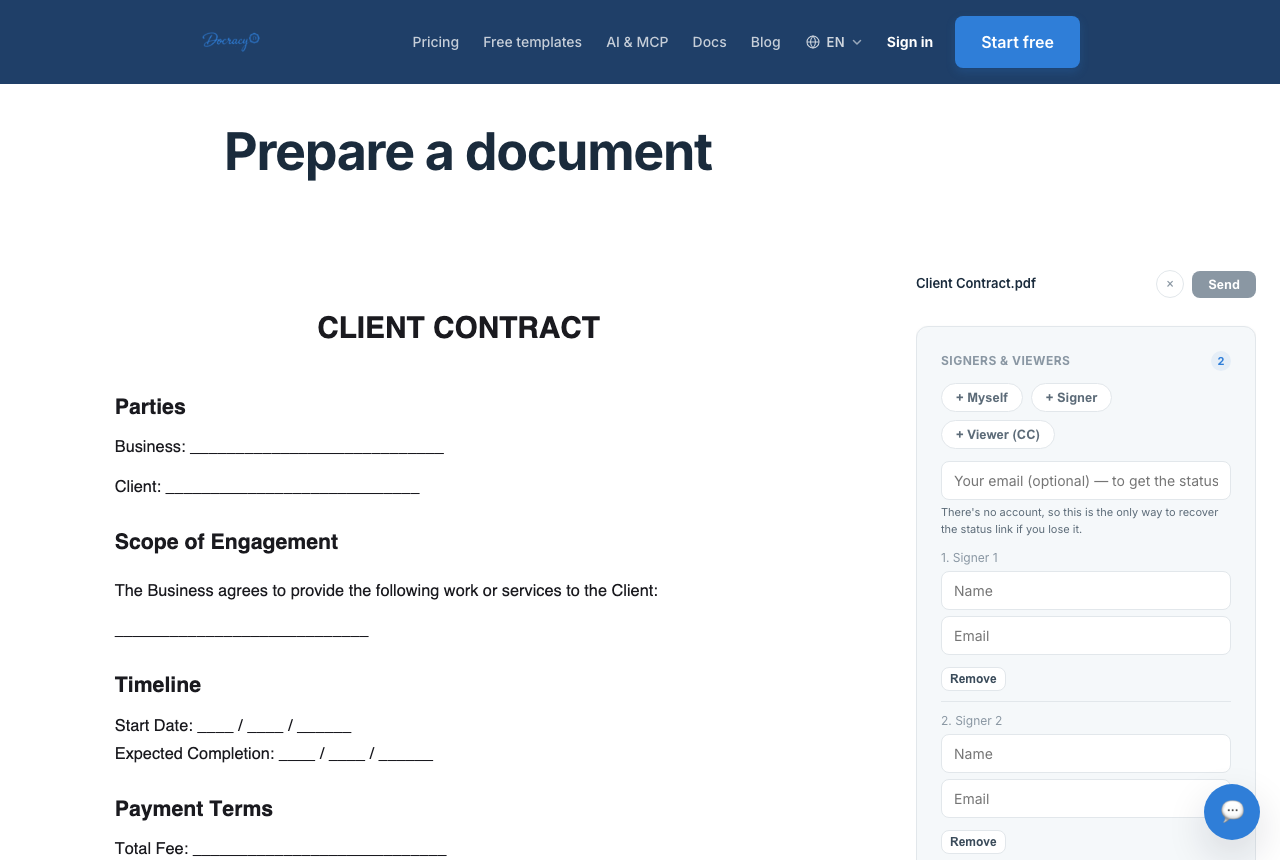

A simple contract outlines expectations, responsibilities, and payment terms. It doesn't need complex legal language — clarity is more important. Two paragraphs that say exactly what's being delivered, by when, and for how much will hold up better in practice than three pages of dense legalese nobody reads closely. The word "simple" describes the writing, not the stakes — a one-page agreement between two freelancers can be just as legally binding as a fifty-page vendor contract, provided it captures the same core elements: who is agreeing to what, and what happens if either side falls short.
What makes a contract "simple" without making it weak
Simple doesn't mean vague. A short contract can still cover every point that matters — it just says each one in plain language instead of formal clauses. A contract earns the word "simple" by cutting language, not content: every clause a formal contract covers — scope, timeline, payment, remedies — still needs to show up somewhere in a short contract; it just gets stated as a plain sentence instead of a numbered clause with cross-references. The test is whether a person with no legal training could read it once and explain it back correctly.
The four elements that make any agreement a contract
Regardless of length, an agreement becomes an enforceable contract when four things are present: an offer (one side proposes specific terms), acceptance (the other side agrees to those same terms), consideration (something of value changes hands — usually money for work, but it can be a trade of services), and mutual intent to be bound (both sides actually mean for the agreement to be enforceable, not just a casual conversation). A simple contract doesn't skip any of these — it just states them directly instead of dressing them up in formal language.
For example, "I'll design your logo for $400, delivered within two weeks, with two rounds of revisions included" contains an offer, and once the other side replies "agreed," it has acceptance and consideration too. That's already a contract, even before it's put into a formatted document — putting it in writing and signing it just makes it easier to prove and reference later.
What every simple contract should answer
- What is being delivered, specifically enough that both sides would describe it the same way
- By when — a real date or milestone, not "soon"
- For how much, and on what payment schedule
- Who is responsible for providing anything the other side needs to do the work, like files, access, or approvals
- What happens if either side wants to end the agreement early
Common formats a simple contract can take
A simple contract doesn't have to look like a formal legal document to count as one. Common formats include:
- A one-page letter agreement, written as plain prose rather than numbered clauses
- A signed quote or estimate that both sides agree becomes binding once accepted
- An email exchange where one side proposes terms and the other confirms them in writing
- A purchase order referencing agreed pricing and delivery terms
- A short template filled in with the specific deal's details
None of these requires the word "Agreement" in the title or a wall of "whereas" clauses to be enforceable — what matters is that the terms are clear and both sides agreed to them.
When a simple contract isn't enough
Short and clear works well for freelance projects, one-off sales, and small vendor deals. It's the wrong tool for anything involving significant liability, intellectual property transfer, or regulatory requirements. A contract assigning ownership of a patent, a deal worth six figures, or an agreement touching a licensed or regulated activity — healthcare, financial services, real estate transfers — is exactly the kind of situation where "simple" stops being an asset and starts being a risk. Pay a lawyer for an hour of review even if the resulting document is still only two pages.
A short example, start to finish
Say a freelance writer agrees to write eight blog posts for a small business at $150 each, delivered two per week over a month, payment due within 15 days of each delivery. Written as a simple contract, that's one paragraph: what's being delivered (eight 800-word blog posts on agreed topics), the schedule (two per week for four weeks), the price ($150 per post, $1,200 total), and the payment terms (net 15 per delivery). Add a sentence on what happens if either side wants to stop early — say, the client pays for posts already delivered and either side can end the arrangement with a week's notice — and the contract answers every question likely to come up over the four weeks of work.
Frequently asked questions
Does a simple contract need to be notarized?
No, in almost all cases. A signed contract between two parties is generally enforceable without notarization — notarization matters for a specific, narrower set of document types, not everyday business agreements.
Can a simple contract be sent and signed the same day?
Yes — that's usually the point. A one-page contract with clear terms, sent for e-signature, can go from draft to fully signed in minutes rather than the days a mailed or printed contract would take.
Is a text message or email exchange a legally valid contract?
Often yes, if it clearly shows an offer and an acceptance — courts have enforced agreements made entirely over email or text. The risk isn't legal validity, it's proof: a scattered thread is harder to point to later than a single signed document, which is why it's worth consolidating agreed terms into one document even after they're settled informally.
What's the difference between a contract and an agreement?
In everyday use, none — the words are used interchangeably. Legally, "agreement" is sometimes used more loosely for an understanding that may or may not be enforceable, while "contract" implies all four elements above are present. In practice, if it's written down, both sides signed it, and something of value is exchanged, it will be treated as a contract regardless of what it's titled.
Why teams start with Docracy
“Docracy is a great product that I have tested and am using. It is easy to use, has good tools, is always up to date, and implements new features. Highly recommended.”— DACH Advisory


Also: Compare e-sign pricing · Free mutual NDA template
No account required for up to 2 signers.